Chaim Lerner's suicide
Here There Is No WhyChaim Lerner's suicide is the disputed fall from the balcony of his Jerusalem home that becomes the decisive mystery of the narrative. The physical fact is unmistakable: Chaim's body lies twisted on the sidewalk, beyond any plausible hope of resuscitation. The meaning of that death is not. One account says that he jumped; another leaves open a fall or murder. Because Chaim was a Holocaust survivor, a celebrated writer, and a man who had spent his life turning catastrophe into theology and testimony, the question of how he died becomes inseparable from the question of what his life meant.
Causes and Background
The case initially appears to contain several ordinary explanations for suicide. Chaim had struggled with depression and the illnesses of age, including a damaged knee and a painful hip, and he had lost a parent. Later commentators also connect his death to the delayed burden of the Holocaust. Bella Shmozic called him “the six million and first victim, and the eighth Holocaust writer,” placing him in a grim sequence of writers associated with Holocaust testimony who took their own lives. Her interpretation treats the survivor-writer as someone compelled to keep seeing and converting unbearable experience into narrative until the act of seeing itself becomes fatal. A story Chaim had published about a blind sixty-year-old who suddenly gains sight and then dies from the excess of sensation becomes, in Shmozic’s reading, an allegory of that vocation: too much horror enters the mind, and the mind can no longer mediate it.
Yet the evidence against a simple suicide is equally forceful. Chaim left no note, used an unlikely method, and spent the week of his death actively preparing for the future. He had signed a contract for a new book on Zionism, bought two plane tickets for a long-promised vacation in Italy with his wife, and accepted a teaching assignment at Hebrew University on Western literature. His dean found a complete syllabus and lecture notes among the papers on his desk. These were not merely vague hopes; they were concrete projects already taking shape.
The people around Chaim described him as joyful, genial, vital, satisfied, loving, and enthusiastic. He did not fit the expected image of a haunted Holocaust survivor: friends and relatives did not remember him as revenge-driven or consumed by mourning. His writings returned to Auschwitz, but his life in the Jewish homeland was presented as a celebration of freedom. The apparent contradiction gives the case its peculiar force. The person repeatedly described as “The last person you would expect to commit suicide” is precisely the person whose death demands an explanation.
What Happens
Judah Loeb reaches the house by accident—or by a last-minute impulse—on the night he is leaving Jerusalem. Three days after an intimate farewell with Michal, a Mercedes taxi collects him from his dormitory for an 11:30 p.m. flight. Remembering that Chaim's birthday is four days away and that Chaim usually eats dinner at eight, Judah asks the driver to make a brief stop at the house on Jeremiah Street. Darkness has already covered Jerusalem, and the ambulance's red lights initially resemble stars.
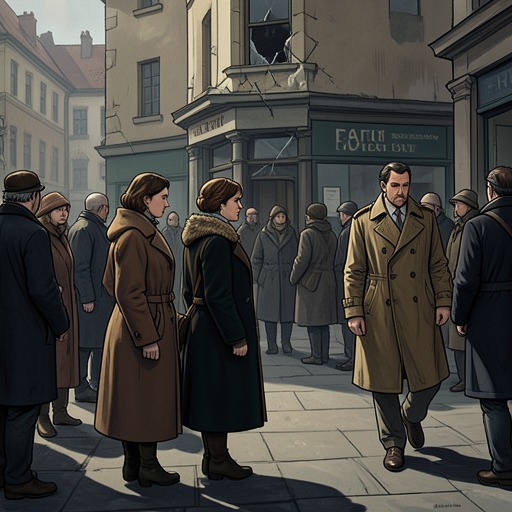
The scene immediately denies any peaceful interpretation. Four men lift a prone, twisted body onto a stretcher and rush it toward the ambulance. Zehava Lerner and Michal stand on the lawn, while neighbors gather across the street. Michal recognizes Judah first and throws an arm around his neck, screaming that Chaim is dead. Seeing the place where the emergency workers have lifted the body, Judah identifies the location beneath the side balcony. Michal assumes that Chaim fell and asks what he could have been doing there alone.
Zehava rejects that explanation with absolute certainty. She insists that Chaim did not fall but jumped. Her declaration is repeated as Judah leaves: “He didn’t fall,” she announces. “He jumped!” The words address not only Michal and the neighbors but, in Judah's perception, Jerusalem and history itself. They establish suicide as the first public account of the death, before any investigation can test it.
The physical scene later sustains a homicide theory as well. When Charlie proposes treating the case as murder, Judah remembers Chaim's broken body on the sidewalk and the emergency workers' futile attempt to revive him. Charlie, a homicide detective, asks who the obvious suspects would be; Judah answers, softly, that the family is the textbook possibility. The investigation therefore begins not from certainty but from competing narratives attached to the same body: jump, fall, or push.
Evidence and Competing Interpretations
Chaim's own ideas about survival complicate the suicide theory. In an interview conducted on his balcony less than a month before his death, he explains his survival through luck, timing, professional training, and knowledge of German. He had fled to the forest early in the war, reached Auschwitz relatively late, possessed a chemistry degree valued at selection, and understood the orders of the guards. He then proposes a more disturbing explanation: survivors may have required a degree of selfish instinct to avoid death in the lager. But his theory of chayut, or life force, finally refuses to turn survival into moral reward. His father and brother became what the camps called musselmen, though Chaim insists they were better men than he was. Survival remains important to him, but its ultimate cause is “totally without meaning.”
The interview directly anticipates the question of survivor-writers who die by suicide. Asked about the “Paul Celan syndrome,” Chaim notes that such writers left no suicide notes. Their work, he suggests, may be their note. That possibility makes the absence of a final message both thematically resonant and evidentially frustrating. Chaim's books can be read as a long explanation of his relationship to death, but they cannot establish what happened on the balcony.
His testimony repeatedly emphasizes interruption rather than total darkness. At a meal with Judah and Zehava, he recalls working as a slave laborer in Buna, the Auschwitz rubber factory. A fellow prisoner smuggled in a mealy apple; four men hid behind a machine, risking beating or death, and divided it into four pieces. Chaim remembered God in the juice and pulp. He also recalls the naked ankle of a civilian secretary, the first woman's body he had seen in nearly a year. The sight was not erotic, he explains, but beautiful, and it made the prisoners suddenly aware of their own corpse-like smell. He calls such fragments “Moments of reprieve.” The apple and the ankle do not erase horror; they prove that horror never completely occupies the world.
That life-affirming theology becomes an argument against suicide, though not a conclusive one. Chaim's writings find miraculous pleasure in an apple slice, wry irony in the ethics of theft at Auschwitz, and religious possibility in a God whose power is limited but whose love is infinite. His final book, Our Imperfect God, becomes internationally famous after his death and offers faith to readers who can no longer believe in an omnipotent deity. The books make the death more mysterious because they preserve a thinker committed to finding light within catastrophe.
Investigation, Withheld Truth, and Consequences
Judah's investigation gradually becomes entangled with the ethics of testimony. He is not merely asking whether Chaim jumped; he is trying to determine whether a survivor's death should be interpreted through the Holocaust, through family violence, through political guilt, or through the ordinary pressures of aging and illness. The case also exposes the danger of allowing a compelling theory to replace facts. Narratives about the Holocaust writer as a doomed witness may illuminate Chaim's life, but they can also turn his death into a literary pattern before the particulars have been established.
The family's role remains especially charged. Judah identifies the family as the obvious suspect, and later evidence confirms that the household contains violence, secrecy, and motives for concealment. At the same time, the public story is shaped by Zehava's immediate insistence that Chaim jumped. Her certainty may be testimony, interpretation, or an attempt to control the meaning of the scene. The investigation therefore treats speech itself as evidence while recognizing that every speaker has something at stake.
The inquiry eventually reaches a point at which further knowledge becomes unavoidable. Judah tells Hannah that he does not want to know what happened to Chaim, but unfortunately does know. The sentence marks the collapse of his earlier position as a distant investigator. The death has become part of his own family history, bound to Mary Loeb's suicide, Hannah's childhood discovery of her mother's body, and the secrets withheld across generations. Hannah's later understanding of suicide does not resolve the case by supplying a neat causal answer. Instead, she challenges the demand that every death be made intelligible through a single why.
Thematic Significance
Chaim's suicide functions as both an event and a test of interpretation. The balcony is the point where incompatible explanations meet: a man planning books, travel, and teaching may still have killed himself; a joyful survivor may still have carried an invisible wound; a writer who treats his work as a possible final message may leave no literal note. The narrative refuses to make any one of these propositions sufficient by itself.
The death also links private grief to collective responsibility. Chaim's later political concerns include Zionism and contemporary Israeli life, while his historical consciousness remains marked by the Holocaust and by the failure of bystanders to intervene in the massacres at Sabra and Shatila. His death consequently enters a wider moral field in which action, inaction, memory, and retrospective explanation are constantly disputed. Whether he jumped, fell, or was pushed, the body becomes a site where personal suffering and public history are forced into the same frame.
The final significance of the event lies in its resistance to closure. Chaim's theology insists that darkness is never complete, but his death prevents that principle from becoming a simple reassurance. The surviving characters inherit not an answer but a responsibility to read, remember, investigate, and decide what can be known. In that sense, Chaim's suicide is less the final statement of a life than the unanswered question through which the rest of the narrative continues to speak.